
First arriving crew: recognize, stage and report
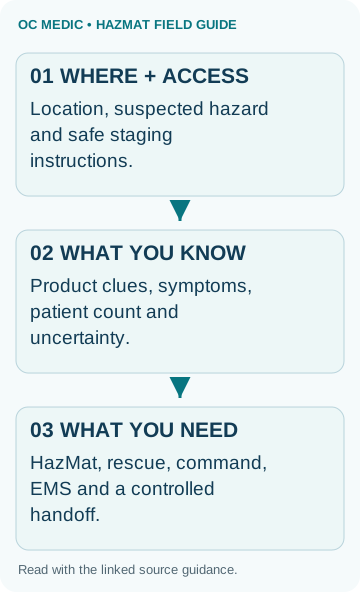
A HazMat incident may first appear to be a routine medical call: several people with the same symptoms, an unconscious worker near a tank, a chemical odor, or a patient carrying contaminated clothing into an ambulance. Pause the routine approach when the scene suggests a shared environmental cause. A single patient can require a full hazardous-materials response.
- Approach from a protected position. Observe weather, terrain, traffic, containers and the movement of people before committing the unit. Favor an upwind, uphill and upstream approach when feasible, but let incident command and HazMat assessment establish the actual safe route and staging area. Buildings, drainage, changing wind and a moving release can defeat a simple compass rule.
- Stop entry and announce the concern. Relay the location, suspected release, visible identifiers, estimated patients, symptoms and safest known approach. State what is observed versus what is unconfirmed. Request HazMat, command, additional EMS and rescue capability as indicated.
- Keep routine EMS resources outside the hazard area. Do not enter to read a label, take a sample, recover a container or attempt an unprotected rescue. Do not use smell as a clearance test. Keep incoming patients and equipment from bypassing the contamination-control process.
- Prepare for a controlled patient handoff. Identify who will communicate decontamination status, where urgent patients will be received, how treatment will be delivered during decontamination by appropriately protected personnel, and which route ambulances will use.
Sources: Cal/OSHA Title 8 §5192 — emergency response roles and training (§5192(q): emergency response plan and responder competencies) · PHMSA — Emergency Response Guidebook 2024 (initial response guidance)
Awareness, operations and technician duties
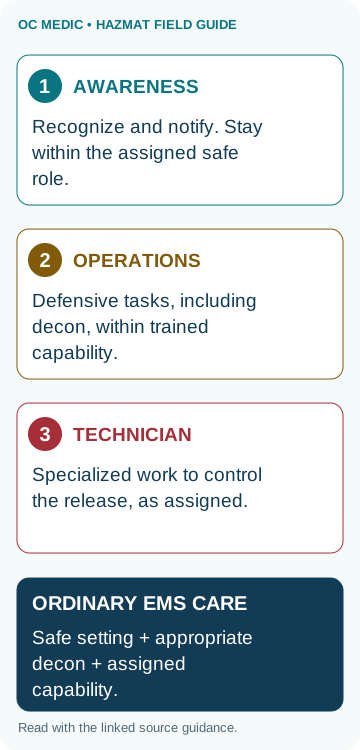
Clinical licensure and HazMat qualifications answer different questions. An ALS scope does not authorize entry into a contaminated area. Your assignment must fit your HazMat training, employer authorization, protective equipment, respiratory protection program and the incident safety plan.
Awareness
Recognize a possible release and notify the appropriate response system. Under California’s emergency-response rule, awareness personnel initiate the response by notification and take no further hazardous-material response action beyond that level. Receive patients for ordinary EMS care only within the safe assignment your employer has established.
Operations
Defensive actions to protect people, property and the environment. California’s listed competencies include basic decontamination and rescue within the unit’s resources and PPE capabilities. A course title alone does not authorize every decon task or entry assignment.
Technician / specialist
Technicians have competencies for approaching and stopping a release. Specialists add substance-specific expertise. These roles require the appropriate training, equipment and incident assignment; they are not extensions of a routine ambulance response.
Incident command
The person commanding a hazardous-substance incident needs the applicable incident-command competencies. General ICS classes support coordination but do not replace HazMat-specific command training.
The federal OSHA EMS interpretation makes the patient-care boundary explicit: awareness-level EMS may provide care after removal from danger and thorough decontamination; handling patients who remain contaminated or only superficially decontaminated requires at least operations-level preparation. Use California requirements and your employer’s task-specific program to determine the actual assignment.
PPE is selected for the hazard and task. Routine gloves, a surgical mask or structural turnout clothing should not be assumed to provide chemical or vapor protection. Command/HazMat must match protection and monitoring to the material, concentration, route of exposure and work. If the assignment exceeds your capability, report the gap and request the right resource.
Sources: Cal/OSHA Title 8 §5192 — emergency response roles and training (§5192(q)(6)–(8)) · OSHA — training requirements for EMS at HazMat incidents (March 31, 2017 EMS interpretation)
Command, control zones and the clean EMS area
Use one incident command structure to coordinate rescue, hazard control, decontamination and medical operations. Expand with groups or branches as workload requires. HazMat provides hazard assessment and control recommendations; command establishes and communicates the operating plan. EMS provides patient condition, time-critical needs, treatment capability and transport demand.
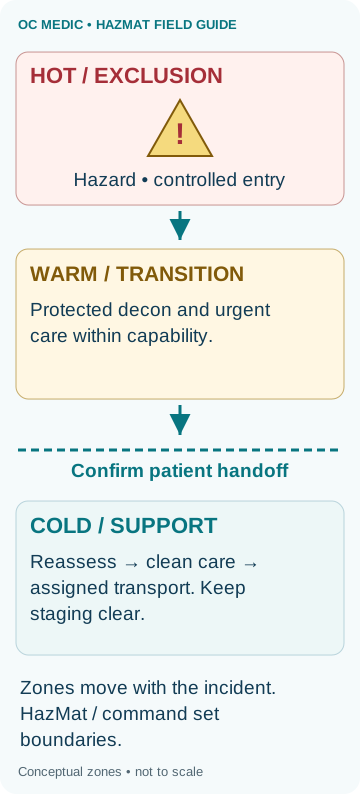
- Hot / exclusion zone: the hazardous area with controlled access and task-specific protection. Its shape is driven by the actual hazard.
- Warm / contamination-reduction zone: the controlled transition used for decontamination and associated functions. It still has exposure potential; ordinary EMS PPE is not a qualification to work there.
- Cold / support zone: command, clean medical care, logistics and ambulance functions as assigned. “Cold” is a managed designation that must be reassessed if the release or weather changes.
Make the boundary an actual handoff
Agree on one patient exit from decontamination and a separate equipment/crew return process. Confirm the patient identifier, contaminant or uncertainty, removal actions, remaining concerns and who assessed readiness for clean care. Keep contaminated clothing, packaging and equipment under the incident’s containment plan. Do not send them through the clean ambulance route by default.
Provide a route for ambulatory patients and an assisted route for children, nonambulatory patients and patients needing immediate interventions. Match staff and protection to both. Keep ambulance ingress, loading and egress available even when the number of waiting patients grows.
Sources: Cal/OSHA Title 8 §5192 — emergency response roles and training (§5192(q): command, safety and decontamination) · HHS CHEMM — patient decontamination (patient movement and contamination reduction) · FEMA IS-700.B — ICS organization graphic (broader ICS organization)
Recognize the hazard and use the ERG correctly
Gather useful information without creating another exposure. From a safe location, obtain a product name, UN/NA number, placard, shipping-paper information, safety data sheet (SDS), witness account, facility contact or remote image. An identifier is a lead to verify; a container may be mislabeled, mixed or involved in a reaction.
The 2024 Emergency Response Guidebook supports the initial phase of transportation incidents. It is a rapid reference for early protective actions, not a complete site-specific response plan or a substitute for specialist assessment.
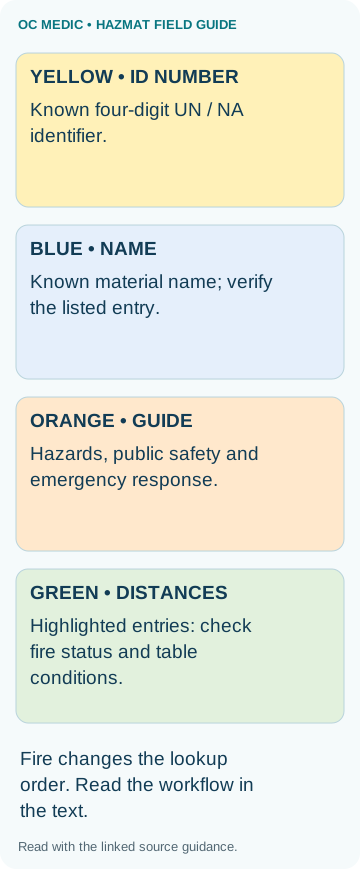
- Known identification number: use the yellow numerical index. With a known material name, use the blue alphabetical index.
- Find the assigned orange guide: read hazards, public safety and emergency response together. An orange guide number is not the material’s four-digit identifier.
- Green-highlighted entry: if there is no fire, consult the green initial-isolation/protective-action tables and the orange guide. If there is fire, use the orange guide’s fire evacuation instructions first, and consult the green tables for residual release. Account for the applicable spill size, time and other table conditions.
- Identity unavailable: follow the ERG’s identification workflow and the incident’s HazMat advice. Never approach just to obtain a number.
Initial isolation around the release and protection downwind are different decisions. Distances in this guide’s scene illustrations are intentionally unspecified. HazMat/command must apply the appropriate current source, monitoring, terrain and incident conditions.
Official ERG PDFERG mobile appsOfficial ERG video & transcript
Sources: PHMSA — Emergency Response Guidebook 2024 (2024 edition) · Transport Canada — ERG 2024 overview and transcript (indices, guide colors and protective-distance workflow)
Exposure and contamination: ask both questions
Exposure describes contact with a hazard through inhalation, skin or eye contact, ingestion, or a wound. Contamination means hazardous material is present on or in the person or their belongings. A patient may remain very ill after leaving the source; a patient who looks well may still carry material that threatens others.
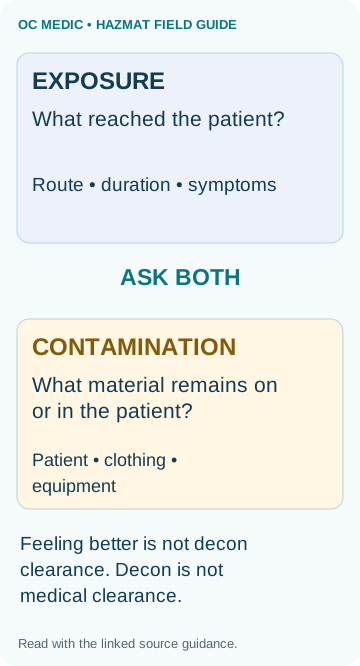
The practical questions are: “What is happening to this patient?” and “Can material on this patient expose someone else?” Document both. A normal initial exam does not clear belongings for an ambulance, and a completed decon process does not clear a symptomatic patient medically.
Clarify whether the event involved only a gas/vapor or also a liquid, powder, contaminated clothing or ongoing off-gassing. Do not assume all inhalation exposures need the same decon method, or that every patient who walked out is clean. Use the identified agent, scene assessment and decon lead’s findings.
Sources: HHS CHEMM — patient decontamination (assessment of contamination and secondary exposure)
Decontamination: method, urgency and patient dignity
Decontamination reduces ongoing exposure and protects the people who provide care next. Begin the appropriate process promptly through trained, equipped personnel. A critical patient needs a coordinated plan for lifesaving care during contamination reduction; routine crews should not cross into an unsafe assignment to speed the process.
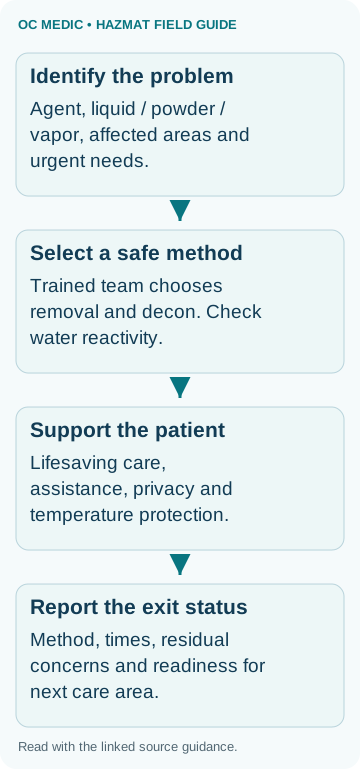
Choose the method for the material
HHS PRISM/CHEMM supports emergency disrobing and appropriate dry removal for many non-caustic liquid contaminants. Dry absorbent methods are not a universal answer for powders or corrosives. Wet methods may be indicated for those materials, but water compatibility must be considered. OCEMS chemical-burn orders specifically warn that some chemicals react with water and can worsen injury or generate hazardous fumes.
For chemical burns, the OCEMS adult and pediatric orders direct removal of remaining dry chemical and copious continuous water or saline irrigation, with that water-reactivity exception. These statements address different tasks: removing bulk dry material before irrigation is not the same as declaring a dry-only decon process complete. Use HazMat product information and base guidance when the material or method is uncertain.
Make decon workable for every patient
- Privacy and communication: explain why clothing removal or washing is needed, provide covering and simple instructions, and use accessible communication or interpretation when available.
- Children and dependent adults: plan assistance, identification and supervision throughout. Keep family connections documented; do not lose a child’s identity when clothing or possessions are removed.
- Cold, heat and mobility: provide replacement covering, warmth or cooling as needed, safe footing, accessible movement and protected support for nonambulatory patients.
- Belongings: label and manage them through the contamination-control plan. A bag does not itself establish that its contents are safe for transport in a patient compartment.
- Exit check: record what was done, timing, remaining contamination concerns and who authorized transfer to the next care area. Reassess clinical condition immediately.
Sources: HHS CHEMM — patient decontamination (PRISM methods and patient decontamination) · Burn (Thermal, Electrical, Chemical) - Adult (page 2: chemical burns and water-reactive exception) · Burn (Thermal, Electrical, Chemical) - Pediatric (page 2: chemical burns)
Medical assessment after a safe handoff
Start with airway, ventilation, circulation and mental status while obtaining the exposure history. Look for respiratory distress, secretions, bronchospasm, altered consciousness, seizure, shock, burns and associated trauma. Support ventilation and suction when needed under the applicable order; do not allow a search for the chemical name to displace immediate clinical assessment.
- What: confirmed or suspected substance, concentration if reliably known, physical form, co-exposures and source of that information.
- How: inhalation, skin/eye, ingestion or wound; enclosed space; contact with contaminated clothes or equipment.
- When: estimated start and duration, time out of the environment, decon start/finish and oxygen or antidote times.
- Who: other affected people, age/weight, pregnancy when relevant, pre-existing cardiopulmonary disease, medications and allergies.
- Trend: repeated respiratory effort, mental status, perfusion and vital signs. Use glucose, ECG and other monitoring as indicated by OCEMS orders; interpret oxygen saturation in context.
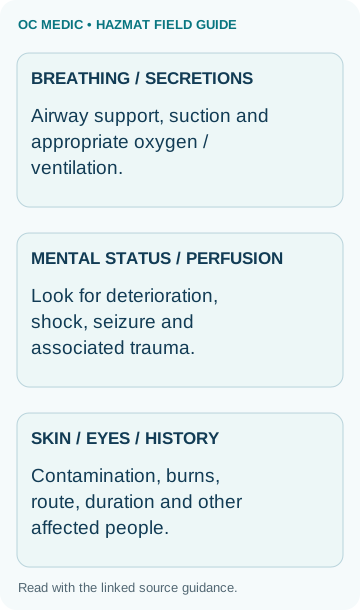
These patterns guide suspicion, not definitive identification. Mixed exposures, trauma and medical causes can coexist. Apply adult poisoning, pediatric poisoning, burn, respiratory and seizure guidance as appropriate. Contact base for unresolved treatment or destination questions.
Sources: Substance Overdose / Poisoning - Adult / Adolescent (pages 1–3) · Substance Overdose / Poisoning - Pediatric (page 1) · Burn (Thermal, Electrical, Chemical) - Adult (pages 1–2) · 9-1-1 Advanced Life Support Base Contact, Standing Order, and Transport Criteria (required and discretionary base contact)
Chemical skin and eye exposure: OCEMS burn integration
A small visible burn does not exclude a significant chemical exposure. Establish which material contacted which body area, whether it remains present, whether dry material was removed, and whether water or saline is appropriate. Continue the chemical-burn process described in the adult or pediatric order, protect against further exposure, reassess pain and tissue injury, and communicate eye involvement early.
Chemical burns are an OCEMS base-contact criterion for burn-unit destination. The trigger is the mechanism, not merely a large percentage of burned skin. Suspected inhalation injury and electrical burns are also listed mechanisms. Contact base to determine an available destination; for pediatric burn patients the order prefers a CCERC pediatric base.
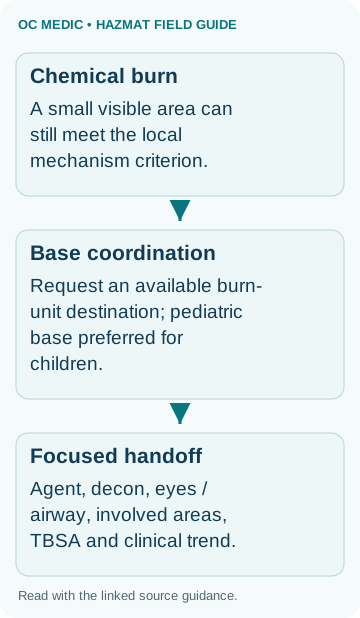
What to include in the burn report
Describe chemical and route, decon/irrigation status, eyes and airway, involved body regions, estimated depth and TBSA, circumferential injury, perfusion, pain and associated trauma. OCEMS also lists burns of the face, hands, feet, genitalia or perineum; circumferential burns; complicating medical conditions; second-degree burns over 10% TBSA; and any third-degree burn among destination criteria. Use PR-03 for the age-appropriate surface-area estimate.
The adult and pediatric orders have different analgesia and fluid instructions. Pediatric SO-P-95 adds base requirements for young children receiving analgesia and for shock management. Open the age-appropriate order before selecting doses; do not copy adult thresholds into the pediatric pathway.
Adult burn guidePediatric burn guideOCEMS PR-03: TBSA & disposition
Sources: Burn (Thermal, Electrical, Chemical) - Adult (page 1 destination criteria; page 2 chemical care) · Burn (Thermal, Electrical, Chemical) - Pediatric (pages 1–2 pediatric differences) · Estimate of Body Surface Area Burned and Disposition (TBSA and disposition) · 9-1-1 Advanced Life Support Base Contact, Standing Order, and Transport Criteria (burn-center coordination)
Smoke, carbon monoxide and possible cyanide
Carbon monoxide: a reassuring SpO₂ can be misleading
Consider CO when people sharing an enclosed environment develop headache, nausea, weakness, chest symptoms or altered mental status, particularly around combustion equipment. A standard pulse oximeter cannot reliably distinguish oxyhemoglobin from carboxyhemoglobin. A normal displayed saturation does not rule out CO poisoning or remove the indication for oxygen in the OCEMS CO pathway.
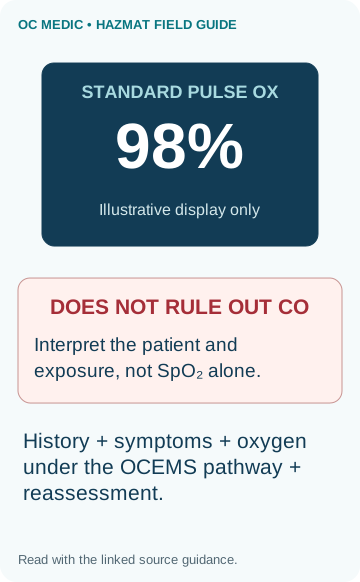
SO-M-50 directs high-flow oxygen by mask and cardiac monitoring with rhythm documentation for suspected adult CO toxicity. SO-P-85 directs high-flow oxygen as tolerated for pediatric CO or cyanide poisoning and ALS escort to the nearest appropriate ERC for suspected pediatric poisoning. The burn orders likewise specify high-flow oxygen with enclosed-space or smoke-related burn injury. Support inadequate ventilation as required.
Tell base about syncope, altered mental status, chest pain, pregnancy, persistent symptoms and time out of the environment. Destination and further evaluation should consider the patient’s condition and exposure history, not a lone monitor value. Do not use hospital hyperbaric-treatment thresholds as an independent field refusal or destination rule.
Cyanide: connect suspicion to the authorized pathway
Enclosed-space smoke, especially from burning plastics or petroleum products, can raise concern for cyanide along with CO and airway injury. PR-130 addresses known or suspected cyanide toxicity and smoke inhalation. It begins with base contact for a hydroxocobalamin order and possible burn-center destination. SO-M-50 also identifies the base-order requirement.
PR-130 includes airway support, oxygen, vascular access, preparation/infusion instructions and pediatric dosing. Do not simultaneously administer other medications through the same IV/IO site. Notify the receiving facility if hydroxocobalamin was given, including time and response; it can cause red discoloration and blood-pressure changes. Use the linked procedure and medication guide for the full administration details.
Sources: Substance Overdose / Poisoning - Adult / Adolescent (pages 2–3: cyanide and CO; base order across page break) · Substance Overdose / Poisoning - Pediatric (page 1) · Hydroxocobalamin for Cyanide Toxicity (pages 1–2) · Carbon Monoxide Evaluation (scope and rehabilitation criteria) · CDC — clinical guidance for carbon monoxide poisoning (pulse-oximetry limitations and clinical assessment)
Organophosphate exposure and the antidote handoff
A patient with excessive secretions, tearing, vomiting/diarrhea, small pupils and respiratory compromise after pesticide or suspected nerve-agent exposure needs rapid recognition. The OCEMS B-35 memory aid is SLUDGEM: salivation, lacrimation, urination, defecation, GI upset, emesis and miosis. Prioritize ventilation, suction and the applicable treatment pathway while controlling further exposure.
SO-M-50 and SO-P-85 contain organophosphate treatment instructions with different adult and pediatric atropine doses/routes. B-35 addresses DuoDote autoinjectors and is referenced by the adult order for health emergencies or disasters. An autoinjector is not interchangeable with an arbitrary dose of separately supplied atropine.
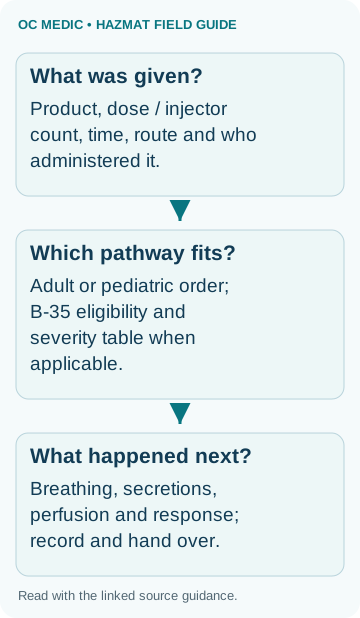
Verify before administration
- Indication and severity: use the exposure history and clinical findings, then the authorized order and B-35 severity table.
- Eligibility: B-35 includes age/weight restrictions: patients under 12 must weigh at least 30 kg to receive an autoinjector, and patients over 65 must weigh at least 80 kg to receive one. Check the full source instead of assuming one injector fits every patient.
- Prior treatment: ask about self-, buddy- or responder-administered antidotes. Confirm product, number, time and route so successive crews do not unintentionally duplicate treatment.
- Ceiling and follow-up: B-35 limits use to no more than three DuoDote doses unless definitive medical care is available and directs appropriate medical evaluation afterward.
Record antidote time, location and product as B-35 requires; transfer this information with the patient and into the PCR. For full dosing and device technique use the DuoDote guide, atropine guide and official source documents.
Sources: DuoDote Antidote Autoinjector (pages 1–2: indications, restrictions, severity table and records) · Substance Overdose / Poisoning - Adult / Adolescent (page 2: organophosphates) · Substance Overdose / Poisoning - Pediatric (page 1: pediatric atropine)
Radiological events and unknown powders
Unknown material should remain unknown until qualified assessment identifies it. Do not open, smell, handle or transport a suspicious package as part of routine EMS care. Request the incident’s appropriate HazMat, law-enforcement and specialist resources, maintain the established boundary, and communicate potential contamination before patient movement.
For radiological events, distinguish irradiation from radioactive material on or inside the patient. Receiving radiation does not by itself mean someone carries radioactive contamination. HazMat/radiation personnel assess contamination and monitoring needs; ordinary clinical appearance cannot determine the radiation risk.
HHS REMM emphasizes treatment of life- or limb-threatening injuries while coordinating contamination management. Avoid making completion of a survey the sole prerequisite for urgent care. Command, protected clinicians and the receiving facility should arrange the safest achievable treatment and transfer for the actual emergency.
Document available survey information with its source, time, units and location on the patient, plus removal/decon actions. Do not convert an unexplained instrument number into a radiation dose or a medical clearance. Isotope-specific countermeasures and specialist testing are beyond this field overview; consult the official REMM resource and medical direction.
Sources: HHS REMM — radiation contamination: diagnose and manage (contamination assessment, management modifiers and medical care) · Cal/OSHA Title 8 §5192 — emergency response roles and training (hazard assessment and assigned capabilities)
Base contact, hospital notification and transport
Notify the receiving system early enough to prepare the arrival route and any remaining contamination precautions. “HazMat patient” alone is not an adequate report. Provide the suspected/confirmed agent, exposure route, patient condition, decon performed, unresolved contamination concerns, treatment and ETA. Confirm the receiving instructions rather than arriving unannounced at a routine doorway.
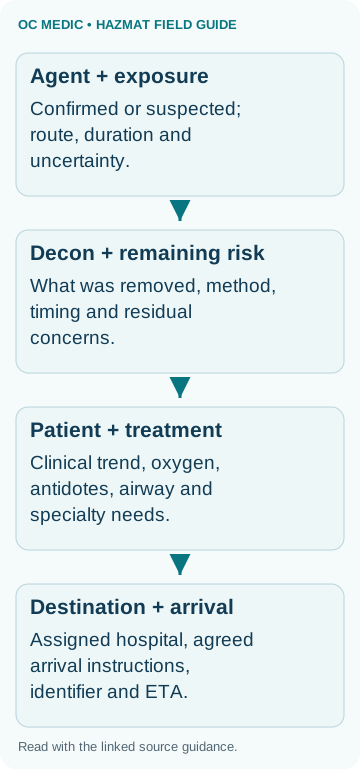
Use the local coordination path
Policy 310.00 requires base contact for the cases it defines and those specified in standing orders; when a standing order requires contact, it must occur before transport begins. Chemical-burn destination and hydroxocobalamin orders are prominent HazMat examples. Base contact is also encouraged whenever the paramedic identifies a benefit or need. Use the base-contact guide for the complete criteria.
When the event becomes an MCI, apply Policy 900.00 and the local MCI field plan. Med Com connects the scene, assigned base and transporting resources. OCC assigns the coordinating base and 6-Bravo through 6-Kilo talkgroup under 900.00. Convey contamination constraints as well as patient numbers so hospital capacity does not get mistaken for readiness to receive a contaminated arrival.
Tag and reassess patients, maintain the complete patient identifier in the patient record, and connect each departure to the ambulance and assigned destination. A walking patient may still need decon and repeat assessment. For expanded triage, transport organization and ambulance strike teams, use the standalone MCI guide.
Sources: 9-1-1 Advanced Life Support Base Contact, Standing Order, and Transport Criteria (pages 1–3: base-contact triggers and pediatric considerations) · Multi-Casualty Incident (MCI) Response Plan (pages 2–4: OCC, Med Com, base and field roles) · HHS CHEMM — patient decontamination (secondary contamination considerations)
Six incident setups for tabletop practice
These are teaching layouts, not measured exclusion zones or OCEMS-approved tactical plans. Command/HazMat chooses the location, protection, distances, monitoring and movement plan. Each example tests the same interface: safe access, contamination reduction, clinical reassessment and coordinated departure.
1. Road or rail release with multiple patients
Start: stage outside the suspected release and traffic hazard. Give dispatch identifiers visible from safety and request HazMat. Do not park all incoming ambulances at the patient collection point before zones are established.
Set up: rescue delivers patients to the assigned decon interface; protected staff manage urgent needs. Clean medical triage and loading follow. One Med Com maintains the destination picture. Request ambulance resources through command as demand grows.
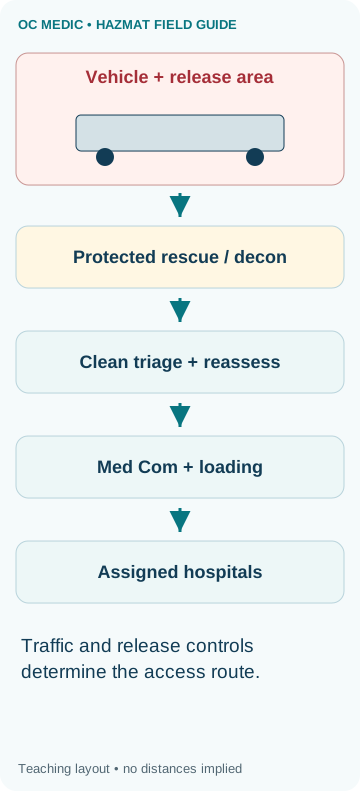
Exercise inject: the wind changes while patients are waiting. Who stops arrivals, moves the medical area and confirms the new route?
2. Pool chemical release at a recreation facility
Start: multiple coughing patients and a chemical-room report suggest a common exposure. Keep crews out of the mechanical room. Separate patient assessment from product identification and source control.
Set up: command establishes safe assembly and decon assessment. Plan accessible assistance, child identification and reassessment of initially ambulatory patients. If a liquid or powder also contacted patients, communicate that information instead of assuming a vapor-only event.
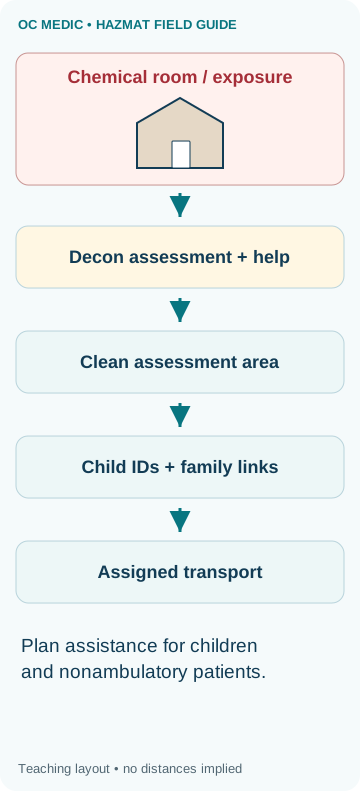
Exercise inject: a parent tries to take a symptomatic child directly to a private vehicle. How will medical evaluation, contamination concerns and family communication be managed?
3. Household CO with several occupants
Start: repeated headache, nausea or collapse in one dwelling warrants environmental evaluation. Qualified personnel control entry and remove people from danger. EMS stages in the designated safe area and evaluates all reported occupants, including children.
Set up: oxygen and repeated clinical assessment under OCEMS orders, appropriate monitoring, exposure timeline and base coordination. Do not use a normal SpO₂ to clear the patient or an initial room reading to authorize re-entry.
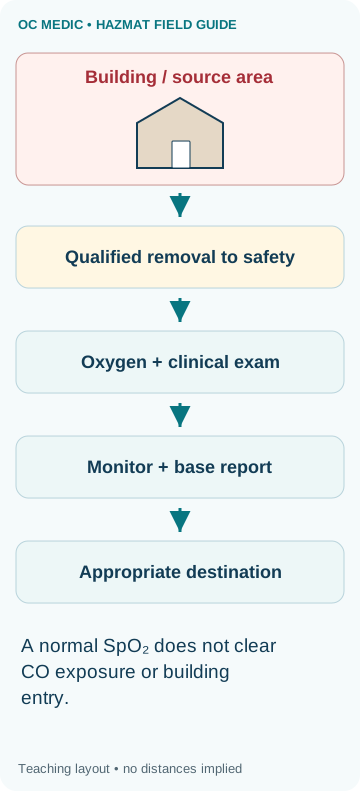
Exercise inject: one patient improves after leaving the building but another has chest pain. What changes in clinical priority and base report?
4. Pesticide contamination at a work site
Start: identify the product through the employer/SDS from safety, request HazMat and protect against contaminated clothing or equipment. Copious secretions and breathing difficulty raise concern for a cholinergic syndrome.
Set up: trained personnel perform agent-appropriate decon while planning urgent clinical support. The medical team verifies antidotes already given, applies the correct age/weight pathway and prepares ALS transport.
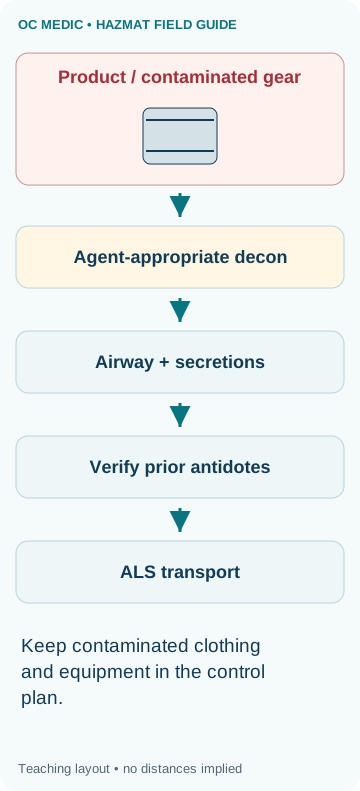
Exercise inject: a coworker reports using an autoinjector but cannot identify the time or product. How is the uncertainty relayed and reconciled before more medication?
5. Industrial splash or a worker down in a tank
Start: a worker in a confined space requires qualified rescue and atmospheric assessment. No spontaneous entry by routine EMS. A patient outside with a chemical splash still needs product-specific contamination management.
Set up: rescue/HazMat hands off through the appropriate decon process. Prepare for airway, skin/eye, shock and trauma assessment. Apply the chemical-burn base-contact criterion even when the visible area is small.
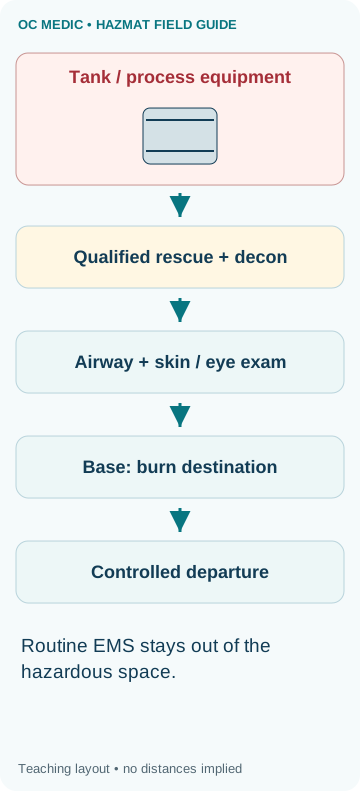
Exercise inject: the SDS identifies water reactivity. Who changes the decon plan, and how do clean-area clinicians receive that update?
6. Unknown powder with possible radiological involvement
Start: isolate access through command and obtain qualified hazard assessment. Keep the package at the controlled scene. Separate reported contact from medically assessed symptoms; identify everyone who may need follow-up.
Set up: specialist survey/decon functions connect to a protected urgent-care pathway and clean medical support. Tell the receiving facility what is known and what remains unconfirmed; preserve identifiers across decon and transport.
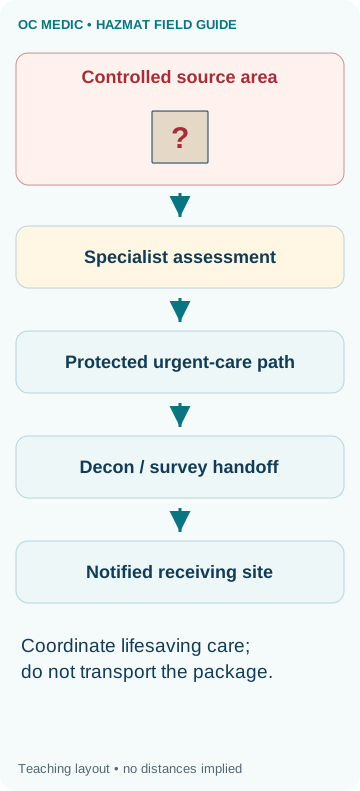
Exercise inject: a patient also has major trauma. How do command, protected care and the hospital prevent a noncritical survey step from delaying lifesaving treatment?
Sources: PHMSA — Emergency Response Guidebook 2024 (transportation incident framework) · Cal/OSHA Title 8 §5192 — emergency response roles and training (role and capability boundaries) · Burn (Thermal, Electrical, Chemical) - Adult (chemical-burn pathway) · Substance Overdose / Poisoning - Adult / Adolescent (CO and organophosphate pathways) · HHS REMM — radiation contamination: diagnose and manage (life-threatening injury priority) · Multi-Casualty Incident (MCI) Response Plan (medical coordination)
Patient records, ICS forms and responder recovery
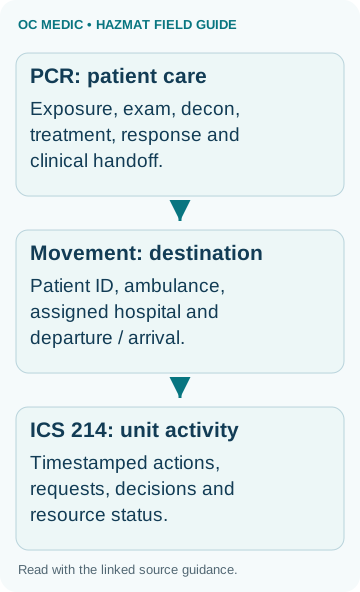
Keep three records connected: the patient’s clinical chart, patient movement tracking and the incident activity record. They answer different questions. ICS 214 does not replace a PCR, and a PCR does not document every command decision or unit status change.
What belongs in the clinical handoff and PCR
Record the exposure history and its source; patient identifier; symptoms and trends; contaminated body areas; decon method and times; oxygen, medication and response; base contact/orders; destination and arrival handoff. Distinguish direct observations from witness reports and unconfirmed product names. Follow OC-MEDS documentation standards and the incident’s patient-tracking process.
Official forms to have ready
| Form / PDF | What it records |
|---|---|
| ICS 201 — Incident Briefing | Snapshot for initial briefing and transfer of command. |
| ICS 204 — Assignment List | Resource assignments and instructions for the period. |
| ICS 205 — Incident Radio Communications Plan | Assigned radio functions and channels. |
| ICS 206 — Medical Plan | Medical support and emergency procedures for incident personnel. |
| ICS 208 — Safety Message-Plan | Incident safety message and precautions. |
| ICS 208 HM — Site Safety and Control Plan | HazMat Group site plan: hazard analysis, zones, monitoring, decon, communications, medical support and emergency procedures. Completed/reviewed through the assigned HazMat command process. |
| ICS 211 — Incident Check-In List | Accountability at arrival and check-in. |
| ICS 214 — Activity Log | Notable activities for a unit, leader or other assigned resource. |
| ICS 221 — demobilization check-out | Authorized checkout before departure. |
ICS 214 — short worked example
Enter the incident, operational period, resource/position, agency and assigned personnel. Timestamp notable activities in Block 7 and complete the preparer information in Block 8. Example entries: “09:12 — staged at command-designated cold-zone access”; “09:18 — requested assisted decon capability through supervisor”; “09:31 — patient handoff point relocated after command update”; “10:04 — unit unavailable pending equipment assessment.” Use approved clinical and movement records for patient details, rather than placing unnecessary identifiable medical information in a widely shared activity log.
Close the exposure loop
Report suspected responder exposures immediately through the employer’s process; obtain appropriate medical evaluation and preserve exposure/PPE/task information. Do not return a unit, reusable equipment or clothing to service until the required decon, inspection and release process is complete. Reconcile patients, resources, logs and outstanding follow-up before demobilization.
Sources: OC-MEDS - Clinical Document Standards (OC-MEDS clinical documentation) · Multi-Casualty Incident (MCI) Response Plan (patient tracking and MCI reports) · FEMA — ICS forms library (official ICS forms) · Cal/OSHA Title 8 §5192 — emergency response roles and training (responder safety and medical surveillance provisions) · Prehospital Exposures (pages 1–3: actual policy scope)
Training: awareness, operational skills and ICS
Choose training against the job your agency expects you to perform. Recognition and notification, decontamination, entry, technical control and incident command require different preparation. Check prerequisites, employer acceptance, hands-on competency, respiratory protection and refresher requirements before treating a completion certificate as assignment authority.
Hazardous Materials Awareness
Online · 8 contact hours
Recognition, ERG use and awareness-level protective actions. Confirm employer acceptance and any local practical requirements.
Open AWR-358 dLCalifornia HazMat training pathway
State outreach program
Find the California awareness, operations and specialist pathway with your training officer; the linked page describes the outreach program.
Open Cal OES / CSTIIntroduction to Hazardous Materials
Online · introductory education
Useful background. FEMA explicitly says this course does not meet HAZWOPER hazardous-material response requirements.
Open IS-5.AEmergency Medical Response Awareness for CBRNE
Online · 8 contact hours
EMS exposure, contamination and triage education. It includes SALT; use the locally adopted triage system on an OC incident.
Open PER-271-WHazardous Materials Operations
Instructor-led · 40 contact hours
Defensive operations and hands-on exercises. Review prerequisites, employer role, PPE and competency requirements.
Open PER-322Official ERG orientation
Video + readable transcript
Practice lookup, guide colors and isolation/protective-action decisions. Download the current ERG for your response kit.
Open ERG 2024Decontamination and PRISM resources
Reference and training material
Support agency decon planning and drills, including method selection, patient assistance and contamination control.
Open HHS CHEMMRadiation contamination management
Clinical reference
Review contamination assessment and how urgent medical needs affect the decon pathway.
Open HHS REMMICS and NIMS foundations
These courses build the command and coordination skills used throughout the guide. ICS-300 is instructor-led; the FEMA page links to the training framework rather than an online independent-study substitute.
| Course | Delivery / purpose |
|---|---|
| IS-100.C Introduction to the Incident Command System, ICS 100 | Online independent study Common terms, roles and the basic organization. |
| IS-200.C Basic Incident Command System for Initial Response, ICS-200 | Online independent study Initial-response supervision and transfer of command. |
| ICS-300 / E/L/G0300 Intermediate ICS for Expanding Incidents | Instructor-led; locate a state/local offering Expanding organization, planning and resource management. |
| IS-700.B An Introduction to the National Incident Management System | Online independent study How NIMS supports coordinated incident management. |
| IS-800.D National Response Framework, An Introduction | Online independent study How the broader national response framework fits together. |
A crew drill that tests the interface
- Choose one of the six scenarios and give the crew only the dispatch information.
- Ask for the first radio report, staging decision and resource request.
- Have command change one condition: wind, product identity, patient count or decon capability.
- Run one urgent and one ambulatory patient through identification, contamination assessment, handoff and destination assignment.
- Reconcile the PCR, movement record and ICS 214; identify a concrete change to equipment, training or communication.
California §5192(q)(8) requires annual refresher training of sufficient content/duration to maintain competencies or an annual competency demonstration, with documentation. The emergency-response provision is not a blanket rule that every awareness responder must take an eight-hour annual class. Use the employer’s documented program and applicable requirements.
Sources: FEMA CDP AWR-358 dL — Hazardous Materials Awareness (awareness course) · FEMA IS-5.A — An Introduction to Hazardous Materials (explicit HAZWOPER limitation) · Cal OES / CSTI — HazMat Outreach Program (California training program) · FEMA CDP PER-271-W — Emergency Medical Response Awareness for CBRNE Incidents (EMS CBRNE course) · FEMA CDP PER-322 — Hazardous Materials Operations (hands-on operations course) · Cal/OSHA Title 8 §5192 — emergency response roles and training (§5192(q)(6)–(8))
OCEMS source crosswalk and editorial notes
This is an independent OCMedic educational synthesis, not an OCEMS HazMat protocol or an incident-specific safety plan. OCEMS sources govern the local medical-care points summarized here; Cal/OSHA, PHMSA, HHS and FEMA resources supply training and incident-management context. National course content does not automatically replace local orders or the MCI triage system.
| Official source / version | Guide application |
|---|---|
| 9-1-1 Advanced Life Support Base Contact, Standing Order, and Transport Criteria 310.00 · final implementation 10/01/2025 | Base-contact requirements and destination coordination. |
| Burn (Thermal, Electrical, Chemical) - Adult SO-E-05 · revised 02/16/2024 | Chemical/inhalation burns, irrigation exception and burn-center criteria. |
| Burn (Thermal, Electrical, Chemical) - Pediatric SO-P-95 · revised 02/18/2024 | Pediatric burn care, pediatric base preference and age-specific instructions. |
| Substance Overdose / Poisoning - Adult / Adolescent SO-M-50 · revised 09/17/2021 | Adult CO, cyanide, organophosphate and supportive care pathways. |
| Substance Overdose / Poisoning - Pediatric SO-P-85 · revised 07/18/2023 | Pediatric poisoning, oxygen, atropine and ALS transport. |
| Hydroxocobalamin for Cyanide Toxicity PR-130 · original/implementation 10/05/2018 | Base order, administration precautions and receiving-facility notification. |
| DuoDote Antidote Autoinjector B-35 · revised 11/01/2016 | Autoinjector eligibility, severity table, limits and documentation. |
| Carbon Monoxide Evaluation SO-F-06 · original 11/01/2016; implementation 04/01/2017 | Fire-service ARN evaluation of firefighting personnel only. |
| Estimate of Body Surface Area Burned and Disposition PR-03 · county linked October 2023 file | Burn surface-area estimation and disposition reference. |
| Multi-Casualty Incident (MCI) Response Plan 900.00 · effective 01/01/2026 | Med Com, OCC/base, destination assignments and tracking. |
| OC-MEDS - Clinical Document Standards 300.10 · county linked October 2024 file | Clinical chart requirements; separate from incident logs. |
| Prehospital Exposures 330.96 · effective 09/02/2014 | Communicable-disease exposure follow-up, not chemical clearance. |
Source check: October 10, 2026. The county’s current online listings and linked source documents were checked for this draft. A source-check date is not the revision date printed on each policy, and it does not claim independent clinical approval. The older source dates are retained deliberately. For changes, use the current county directory and the official source document.
Original OCMedic diagrams are schematic teaching aids. The attributed FEMA organization graphic is reproduced without content changes. Neither source inclusion nor an agency graphic implies agency endorsement.
Editorial approachMCI companion guideCurrent OCEMS source directory
Sources: OCEMS — current policies, procedures and standing orders (current source directory) · Cal/OSHA Title 8 §5192 — emergency response roles and training (California emergency-response requirements)
Tabletop check: prove the clean-care handoff
At the transition to EMS care, have the receiving crew repeat back the suspected agent and information source, decontamination performed, unresolved contamination concerns, urgent clinical needs and the approved movement route. Ask who can resolve a remaining safety question. “Patient deconned” alone should not be the entire exercise answer.
This is a teaching check, not a substitute for the incident’s safety plan or an independent clearance standard. The scene diagrams deliberately provide no measured boundaries or PPE selection. If the exercise requires entry or care of a contaminated patient, confirm that the assigned personnel, training, protection and supervision match that duty. Record uncertainty honestly and coordinate urgent care through capable teams rather than allowing a diagram to imply permission.
Source: Cal/OSHA Title 8 §5192 — emergency response roles and training.